

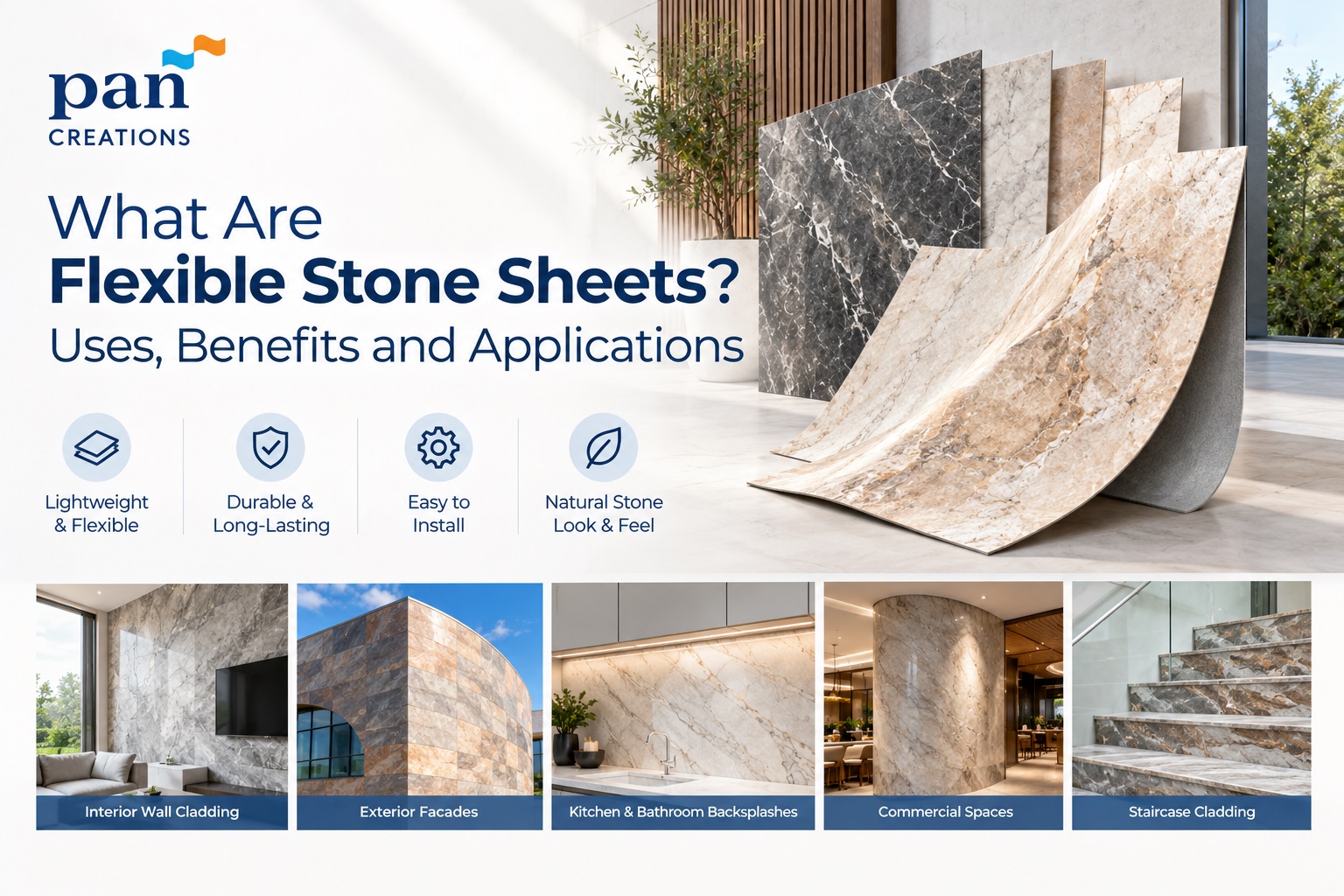
Modern architecture demands materials that balance raw, authentic mineral texture with practical construction methods. While heavy stone blocks and thick slabs have defined luxury for centuries, their weight and rigidity introduce engineering hurdles, high freight bills, and structural limitations. Contemporary commercial builders and interior developers frequently turn to alternatives such as concrete veneer finishes alongside ultralight geological surfaces to solve these structural issues without sacrificing visual substance.
Architects, contractors, and interior designers are turning to thin stone surfacing to combine genuine geological beauty with modern structural efficiency. Among these innovations, flexible stone sheets stand out as a lightweight architectural surface offering real stone character with adaptable workability.
By slicing microscopic layers of real metamorphic or sedimentary rock and bonding them to high-performance backing systems, manufacturers have eliminated the bulk of traditional masonry. At Pan Creations India (Contact No. +91 99298-28229, +91 94133-57766), we produce surfaces engineered to help commercial contractors, project consultants, and builders modernize their surface finishes without traditional masonry drawbacks.
Understanding the Anatomy of Flexible Stone
Traditional stone fabrication produces slabs measuring 20 to 30 millimeters in thickness, requiring heavy anchor systems and specialized load-bearing supports. In contrast, ultra-thin stone surfacing utilizes advanced German technology to peel micro-thin sheets of real slate, quartzite, sandstone, or marble from large quarry blocks.
The resulting surface layer measures between 1.0 and 2.0 millimeters in total thickness. The backing consists of a resilient fiberglass composite saturated with polyester resin, stabilizing the natural stone face while granting it enough bend to wrap curved walls, pillars, and ceilings.
Where standard fiberglass backing reaches its bending limit, Fabric backing Stone Veneer is utilized for applications requiring extra flexibility, tight radial curves, complex millwork wrap, and intricate profile fabrication.
These surfaces retain the tactile roughness, mineral veining, and color shifts of genuine geological strata. Because every sheet is harvested from real rock, no two surfaces share the exact same pattern, giving commercial projects a distinct, high-end profile.
Core Manufacturing: Precision and Engineering
The production workflow relies on specialized polymer fusion and precision peeling. Quarry blocks are prepared with planar cuts, and an adhesion matrix reinforced with German technology is spread evenly across the surface.
Once cured, the backing pulls away with a micro-thin layer of natural stone intact. The extracted panel is then trimmed to standard architectural sizes, such as 1220 x 610 mm, 2440 x 1220 mm, and larger formats.
This technique yields a featherweight panel weighing roughly 1.5 to 2.0 kilograms per square meter. That is a fraction of the 45 to 60 kilograms per square meter common to conventional dimensional masonry, making natural stone veneer one of the most efficient surface solutions for weight-sensitive construction.
Key Advantages for B2B Projects
Commercial developers and specifiers choose thin stone sheets because they resolve real-world logistical, structural, and budget constraints.
1. Significant Structural Weight Savings
High-rise buildings, elevator interiors, and suspended ceilings cannot easily accommodate heavy stone slabs without costly reinforcement. Micro-thin stone profiles eliminate these structural upgrades, speeding up approvals and cutting down on dead load calculations.
2. Lower Logistics and Handling Costs
A single crate of thin stone panels can hold enough square meters to furnish an entire hotel lobby or office wing. Freight expenses drop drastically compared to flatbed trucking for solid slabs, while on-site movement requires only standard handling rather than cranes or specialized hoists.
3. Faster Installation and Minimal Downtime
Traditional stone masonry demands heavy mortar beds, mechanical anchors, and days of noisy dust-heavy cutting. Thin panels can be measured, cut with standard wood carbide blades, and glued directly over existing drywall, cement board, plywood, or clean tile. If you are preparing your job site, review our detailed guide on Natural Stone Veneer Installation Tips to ensure precise substrate prep, adhesive selection, and clean seams.
4. Eco-Conscious Material Optimization
Harvesting hundreds of thin sheets from a single quarry block extracts maximum coverage from finite mineral reserves. Lower fuel consumption during transportation further trims the embodied carbon footprint of your build.
Architectural Applications Across Commercial Spaces
The physical adaptability of thin stone unlocks design opportunities where conventional masonry simply cannot function.
Feature Walls and Corporate Receptions
Corporate lobbies, conference rooms, and hospitality lounges benefit from large-format stone feature walls. Using flexible stone sheets creates uninterrupted floor-to-ceiling focal points that display real mineral texture without the need for heavy anchor bolts.
Substrate layers such as plywood or drywall receive a uniform spread of high-tack polyurethane adhesive. The backing matrix bonds securely to this base, and the thin natural stone face stands finished with clean mechanical alignment.
Feature Lighting and Illumination
When architects seek ambient glow and visible mineral veining in front of lighting or back light applications, they specify UV translucent stone veneer. This variant swaps out opaque backing for transparent resin, allowing uniform LED panels to backlight the real stone grain for striking reception desks, bar fronts, and retail displays.
Wet Environments and High-Traffic Surfaces
Stone adds warmth to luxury washrooms, backsplashes, and hospitality suites. For shower applications, backslash, kitchen top, and vanity zones, the surface must be treated with an Impregnator sealer to block moisture ingress, oil stains, and water marks while preserving the stone’s natural matte finish.
Exterior Facades and Architectural Cladding
Large commercial exteriors benefit from weather-resistant, UV-stable natural surfaces. Builders source flexible stone veneer india for high-volume exterior cladding, gaining natural thermal resilience and distinct curb appeal across residential complexes and corporate parks.
Column Wrapping and Custom Millwork
Rigid stone cannot conform to circular pillars or rounded reception counters. By opting for Fabric-Backed Stone Veneer, joinery teams can wrap radii as tight as a few centimeters without pre-scoring or face-cracking, opening up clean, stone-wrapped millwork details.
Practical Comparison: Thin Stone vs. Traditional Slabs
Understanding where thin stone panels excel helps project managers allocate materials effectively across their projects:
- Dead Load Calculations: Traditional stone weighs 45 to 60 kg/m², demanding structural engineering sign-offs. Thin panels weigh under 2.5 kg/m², making them suitable for lightweight partitions and ceilings.
- Fabrication Tools: Standard slabs require wet saws with diamond blades, bridge cutters, and dedicated lifting gear. Thin sheets can be cut with standard hand circular saws or jig saws fitted with carbide blades.
- Substrate Requirements: Heavy masonry needs rigid concrete or masonry backing. Thin stone bonds directly to drywall, MDF, plywood, plasterboard, and clean masonry.
- Curved Application: Thick slabs require curved milling or small faceted strips. Thin stone wraps smoothly around columns and curved soffits.
Sourcing and Technical Guidance
Working with natural rock surfaces demands an experienced production partner who maintains consistent sheet thickness, reliable resin saturation, and strict color grading across high-volume orders.
With 23 years in veneer manufacturing & 33 years in stone manufacturing & exports, Pan Creations India is among the leading suppliers of this product, delivering consistent quality to architects and trade professionals worldwide.
Our manufacturing operations rely on proven German technology to achieve high adhesion strength between the stone face and backing matrix. This ensures that every sheet of natural stone veneer withstands heavy handling, transport, and site installation across varied climate conditions.
Whether you are coordinating a hotel retrofit or outfitting a modern commercial facade, our technical team provides end-to-end guidance. Project teams can contact Pan Creations India for installation information, specification sheets, and substrate preparation details.
To review catalog finishes, test samples, or discuss project requirements, visit waferthinstone.com or email our technical sales desk at sunil@pancreationsindia.com. For direct project consultations, connect with Pan Creations India (Contact No. +91 99298-28229, +91 94133-57766) to evaluate finishes and schedule samples.
Must Read: What Makes Flexible Stone a Smart Choice for Modern Wall Design?
Frequently Asked Questions
Q1. What tools are needed to cut and shape thin stone sheets?
Ans: Thin stone sheets do not require heavy industrial masonry machinery. Installers use standard carpentry tools, such as circular saws or handheld angle grinders equipped with diamond-grit or fine carbide blades. Straight edges and shears work well for trimming fabric-backed options.
Q2. How do thin stone panels perform against water and outdoor elements?
Ans: Because the front surface is genuine stone and the backing is an impervious polymer matrix, the sheets handle moisture effectively. For wet installations like shower enclosures or kitchen walls, applying a high-grade Impregnator sealer protects the natural stone pores against stains, soap residue, and water penetration.
Q3. Can thin stone sheets be applied over existing tile surfaces?
Ans: Yes. As long as the existing tiles are firmly bonded, level, and thoroughly degreased, thin stone panels can be adhered directly over them using high-strength polyurethane adhesives. This method eliminates noisy, messy demolition during retail or hotel renovations.
Q4. What maintenance is required for long-term commercial performance?
Ans: Day-to-day care is straightforward. Clean the stone face with neutral, pH-balanced stone cleaners or mild soap and water. Avoid harsh acid or bleach-based cleaners. In heavy-use commercial hospitality zones, reapply an Impregnator sealer every two to three years to maintain maximum stain resistance.
Q5. How are expansion joints handled across large commercial walls?
Ans: Just like standard cladding, large surfaces must accommodate building movement. Installers typically leave a 1.5 to 2 mm shadow gap between adjacent panels, filling it with flexible, UV-stable neutral silicone or color-matched polyurethane sealant to accommodate thermal movement seamlessly.